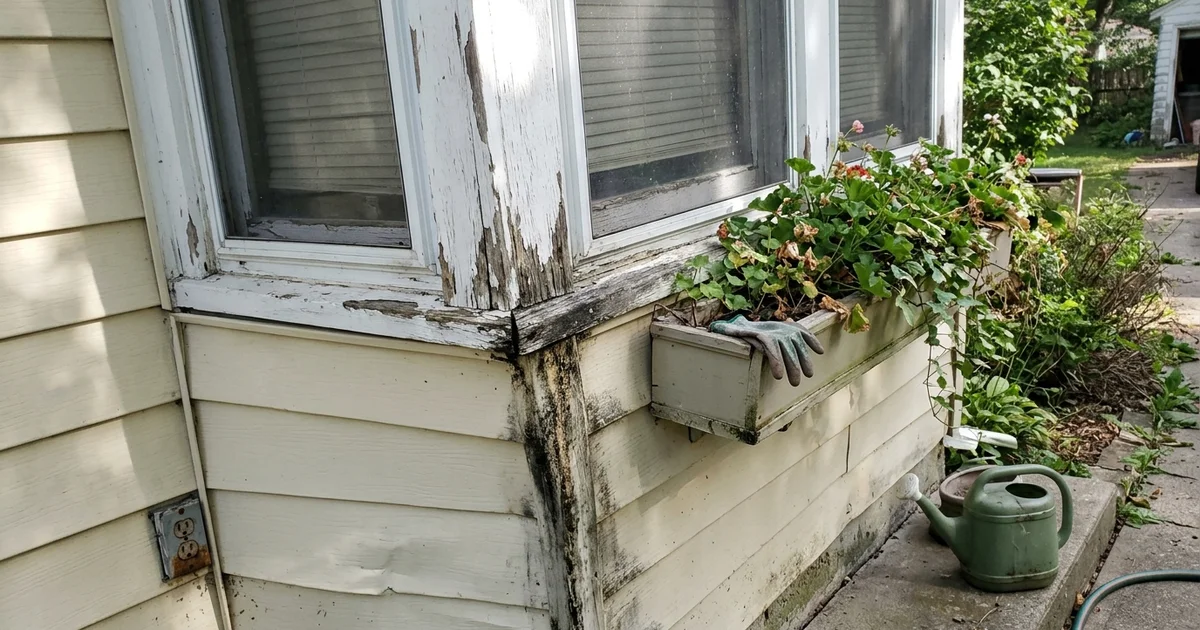
Why Water Behind Siding Is Easy to Miss
Siding is a rain screen, not a waterproof shell. A little water always gets behind it, and a well-built wall lets that water drain out and dry.
The trouble starts when water gets in faster than it can leave, or gets trapped. Then it soaks the house wrap and the sheathing (the wood panels under the siding). The outside can look perfectly fine while the wall rots behind it.
That’s a bigger deal than it sounds. The Building America Solution Center at Pacific Northwest National Laboratory notes that vinyl, fiber cement and brick veneer can hide a leak for years. Older wood siding would have shown peeling paint much sooner.
That’s why so many homeowners find out from the inside first. This guide covers the signs of water damage behind siding, where water usually gets in, and when to call for a look. If you spot something, our siding repair crew can open the wall in just the spot that matters and check it.
Rule of thumb
Stains and soft spots almost never fix themselves. The sooner water is stopped, the smaller the repair.
Warning Signs Outside the House
Walk around the house after a good rain and look for the signs below. Soft spots under windows and near the ground are the most urgent.
- Soft spots. Press on the siding and trim, especially under windows and near the ground. Wood or sheathing that gives under your thumb is wet or rotting. Rotted backing also tends to sound hollow or dull when you tap it, according to Old Glory Roofing.
- Swollen or stained trim. Window and door trim that’s puffy, cracked, dark or peeling is often soaking up water.
- Warped or bulging siding. Panels that bow out in one area, not across the whole wall, can mean the sheathing behind them is swelling. On vinyl, a wavy look in one patch is a common clue.
- Peeling paint on wood or fiber cement siding. Paint that keeps failing in the same spot often has moisture pushing it off from behind.
- Mold, mildew or dark streaks. Especially under windows, below rooflines and on shaded walls.
- Gaps and failed caulk. Open joints around windows, doors, vents and trim are an easy way in.
Warning Signs Inside the House
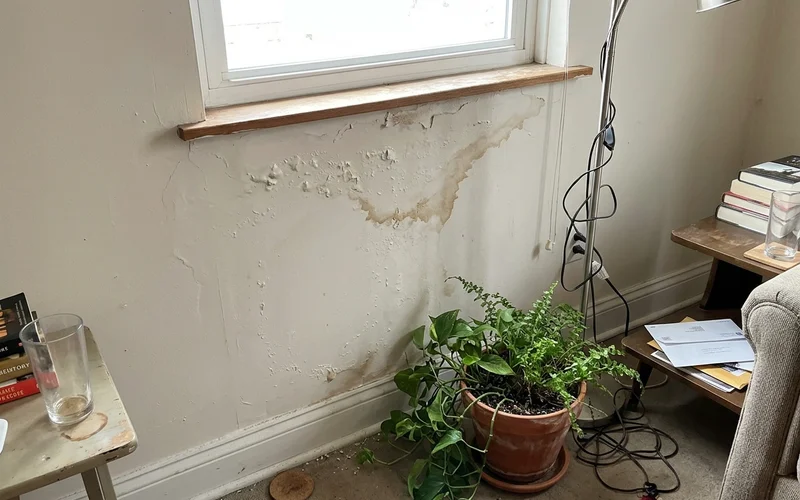
Bubbling paint, stains and a musty smell on or near an exterior wall are the usual signs inside. Because modern siding can hide leaks, these clues often show up before anything looks wrong outside.
- Bubbling or peeling paint on the inside of exterior walls, often under windows
- Water stains on drywall or ceilings near exterior walls
- A musty smell that’s strongest near one wall or corner
- Soft or crumbling drywall at the bottom of an exterior wall
- Warped baseboards or window stools
Mold on an interior wall is a strong hint too. Voyager Exteriors lists mold around windows or inside the home as a sign that water is trapped somewhere it shouldn’t be.
Any of these near an outside wall is worth checking from the outside too.
Where Water Usually Gets In
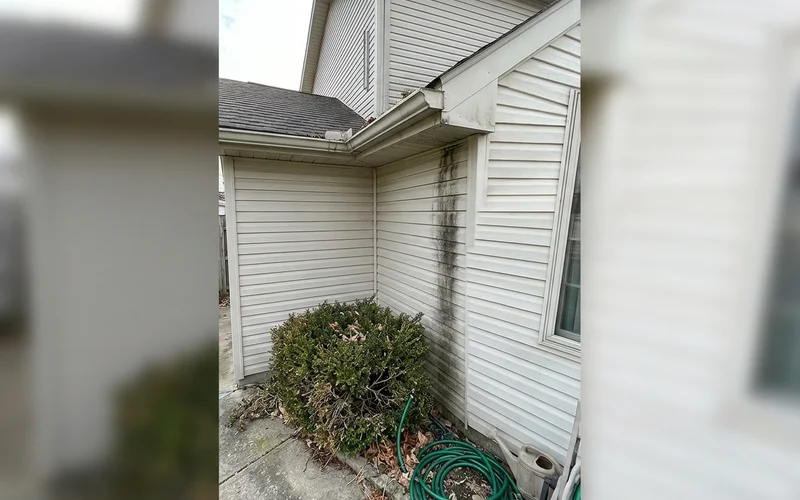
Most leaks start at a few spots: roof-to-wall corners, windows, doors and damaged panels. The Institute of Building Enclosure and Envelope Consultants (IIBEC) points to the 90:1 principle, which suggests 90 percent of water intrusion happens through just 1 percent of the building envelope. Check those spots first.
In our experience on Grand Rapids houses, the usual suspects are:
| Entry point | What goes wrong | Where to look |
|---|---|---|
| Missing kick-out flashing | Roof water runs down behind the siding where a roof meets a sidewall | Below roof-to-wall corners, often over a garage or porch |
| Failed window flashing | Water gets around the window frame into the wall | Below window corners, inside and out |
| Damaged or loose panels | Rain blows straight in through cracks and gaps | Any cracked, holed or loose siding |
| Torn or missing house wrap | Water that gets past the siding has nothing to stop it | Older homes, past repairs, storm damage |
| Blocked weep holes | Water behind vinyl can’t drain out the bottom, and paint is a common culprit | Lower courses of vinyl siding |
| Siding too close to the ground | Boards wick water from soil, mulch and snow. The model building code calls for 6 inches of clearance for wood siding, and 2 inches above concrete steps and patios | Bottom few inches of every wall |
Kick-out flashing is the one we see missed most. The Journal of Light Construction calls it required by code yet often overlooked, and the model International Residential Code has required a flashing to divert water at that corner since the 2012 edition.
Why It Gets Worse Through Michigan Winters
A small leak in fall can turn into a soft wall by spring. Water in a wall doesn’t just sit there. Every time it freezes, it expands, pushing joints, caulk and wood fibers apart a little more.
Every thaw lets in more water. Lake-effect snow piled against walls and melting off roofs keeps feeding it. Grand Rapids got 116 inches of snow in the winter of 2013-14, its second snowiest on record, according to WOOD TV 8’s weather blog. The Great Lakes Integrated Sciences and Assessments program (GLISA) also reports that heavy 1-inch-per-hour snowfalls have increased since 1975, partly because of lake-effect snow.
Warm, wet sheathing also grows mold and rots fast once spring comes. That’s why a stain you noticed in March is worth dealing with before summer.
When to Call for an Inspection
Call for a look as soon as you notice any of these:
- Soft spots in siding, trim or sheathing
- Interior stains or bubbling paint near exterior walls
- The same spot that keeps peeling or staining after you’ve fixed it
- A musty smell you can’t trace to a plumbing leak
We start with a close look outside and inside, and check suspect areas with a moisture meter. A meter reports the wood’s moisture content as a percentage, and that number tells us more than the surface does.
| Reading | What it usually means |
|---|---|
| 12% to 14% | Normal for kiln-dried framing lumber |
| 15% to 19% | Typical for non-kiln-dried or pressure-treated lumber |
| Above 19% | Mold and rot can start, according to the Journal of Light Construction |
| 28% to 30% | Wood is saturated |
We only remove siding where the signs point to a problem. If we find wet or rotted sheathing, here’s what happens next:
- You see the wet or rotted sheathing first.
- The fix and what it adds to the price get explained up front.
- Damaged sheathing comes out and gets replaced.
- The wall closes back up with proper wrap and flashing, lapped shingle-fashion so upper layers sit over lower ones, as the Building America Solution Center recommends.
Most of the time this is a targeted repair, not new siding for the whole house.
Knowing the signs of water damage behind siding is what keeps it that way. If water damage turns out to be on many walls, read siding repair vs. replacement to understand your options.
And if you’d like a Grand Rapids siding contractor to look at it now, request a free estimate.